
13 · Convolution and Deconvolution
Deep dive 13 of Tensors for Machine Learning. One idea, followed from a forward operation to an inverse problem:
A small kernel is reused across positions to transform an image.
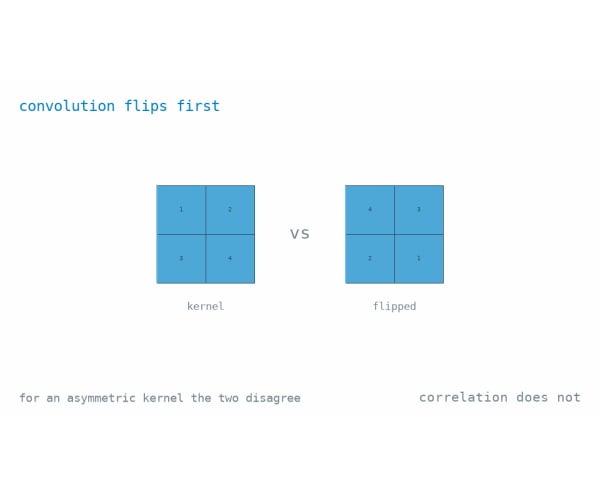
Four words get confused constantly, and this deck keeps them apart. Correlation slides the kernel as written. Convolution flips it first. Transposed convolution scatters each input through the kernel and adds the overlaps. Deconvolution tries to recover an unknown original from a blurred observation. Along the way: the three output modes valid, same and full, convolution written as one Toeplitz matrix product, and the mistake almost everyone makes — that convolution and correlation are the same thing.
Then the inverse problem, on a real photograph: blur it with a known 9×9 point-spread function, add noise, and partly recover it with Richardson–Lucy. It is one of the three places you watch the workshop’s connecting idea happen, alongside the pseudoinverse in section 07 and Tucker in section 10: no exact inverse, so you look for the best stable approximation.
In the six-hour workshop this deep dive is a 25-minute live lab: the predict-first question, Exercise 1 and the deconvolution explorer. Transposed convolution and the rest go home.
Study here, then run the real thing: notebook 13 on Colab · the notebooks
Built from the workshop’s own material by Ravi Kalia and Sebastian Laverde Chunza, CC BY 4.0.
Your path through this unit
Step 1 of 3
Initial review
Take a first look at each topic and tick Got it once you have the general idea.